Tl;dr: The AlphaGo for litigation.
What it is
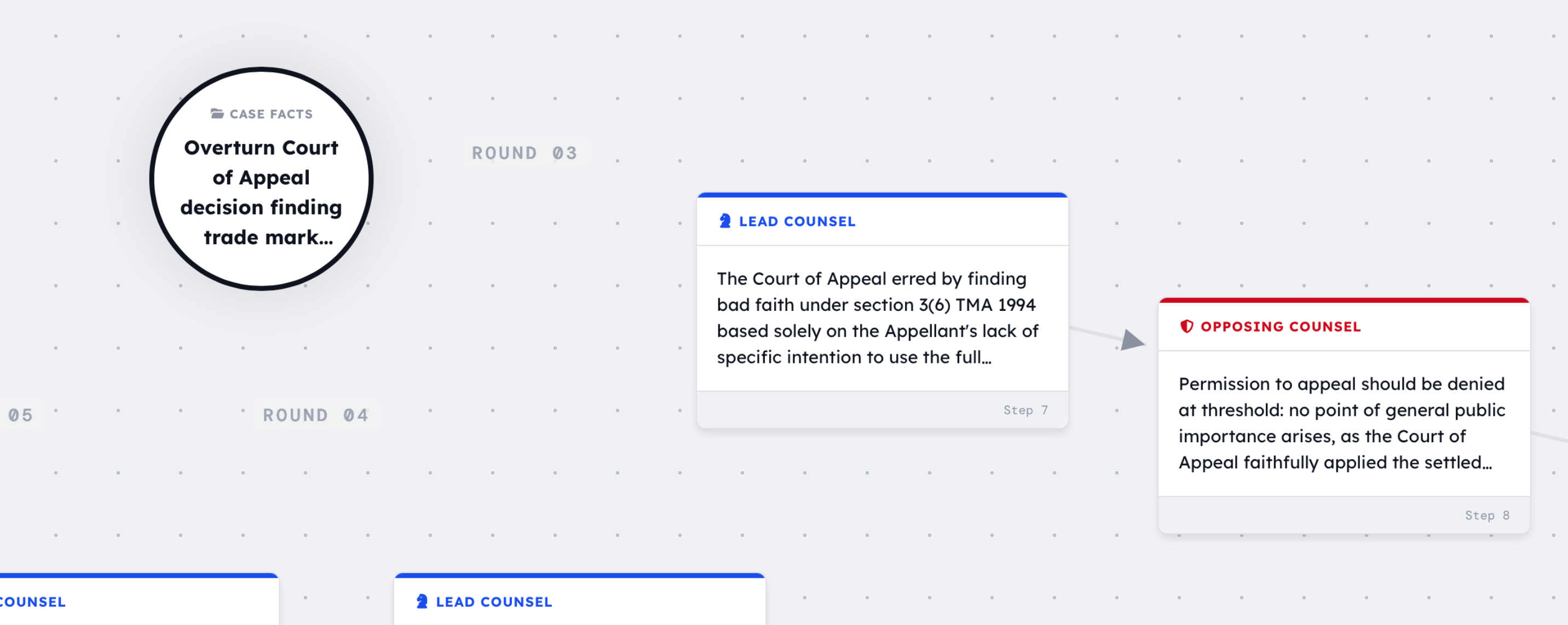
Lawgame is an unsupervised AI system that simulates litigation through adversarial play. Three agents — Lead Counsel, Opposing Counsel, and Judicial Authority — war-game cases across multiple rounds to find dominant strategies.
The system doesn’t predict outcomes. It plays the game. Losses inform pivots. Wins get stress-tested. The goal is to find what human teams miss when they’re too close to the problem or too constrained by conventional thinking.
The breakthrough case
A pharmaceutical company faced $200 million in liabilities for alleged off-label promotion. Traditional counsel advised a $150 million settlement.
Lawgame ran four adversarial rounds and identified an argument a human team would have missed without extensive red-teaming: materiality. The government had continued to reimburse 90% of prescriptions despite knowledge of the alleged conduct. Under Universal Health Services v. Escobar, that made the conduct non-material.
The court dismissed all charges. Zero financial loss.
How it works
The system operates through three layers:
Adversarial Agent Architecture: Structured protocols for burden allocation, evidence-binding, and zero-hallucination verification.
Multi-Orbit Strategic Recursion: Meta-analysis of judicial feedback to explore the full solution space — not just the obvious motions, but second- and third-order consequences.
Innovation Lab: Cross-domain reasoning that exploits logical contradictions and doctrinal reframing across legal boundaries.
Lawgame is model-agnostic. It runs on cloud APIs or air-gapped local models for cases requiring absolute confidentiality.
The market gap
Legacy tools focus on research (Westlaw) or automation (document assembly). Lawgame occupies the strategy layer.
It solves what I call Horizon Bias — the human tendency to focus on the immediate motion without modelling what happens three moves ahead. Traditional war-gaming sessions cost $50,000–$150,000 and take weeks. Lawgame compresses that to minutes.
Nine test cases. Over $1 billion in preserved value or avoided penalties. Seven outright wins.
Access to justice
KC-level legal strategy has historically cost £2,000–£5,000 per hour. That’s a design problem, not an inevitability.
The system is built to serve both commercial clients and an access-to-justice track: elite strategy for legal aid organisations, small firms, and pro se litigants who would never otherwise get it. Commercial work funds the latter. That’s not a business model — it’s a design principle.
Current status
Lawgame v1 is in active use as an R&D tool. The public-facing component is a technical white paper available at lawgame.net.
Roadmap includes settlement dynamics, jury trial simulation, appellate specialisation, and international arbitration. I’m building in sequence, not in parallel.